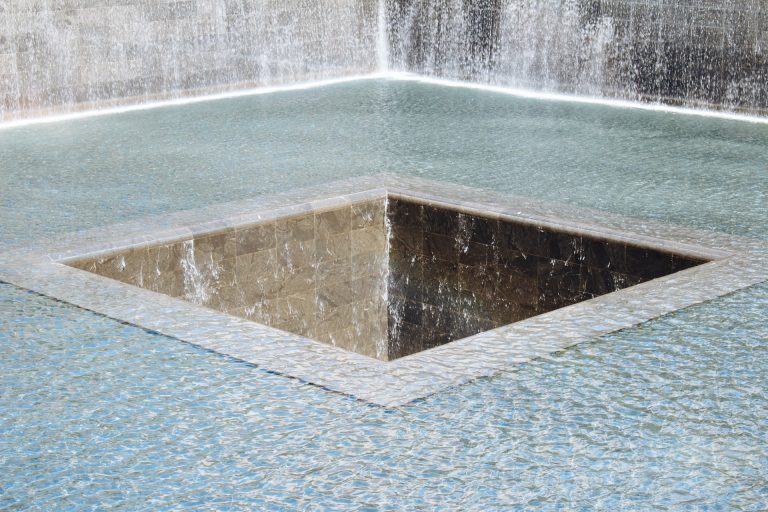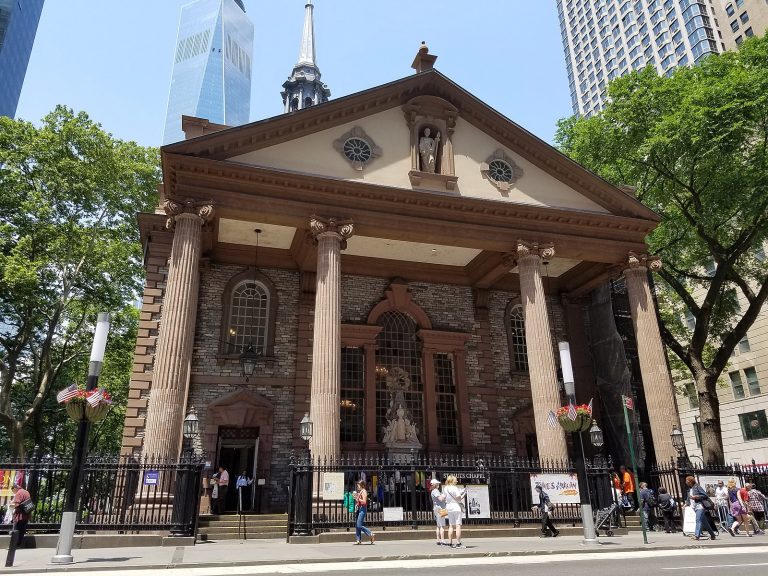
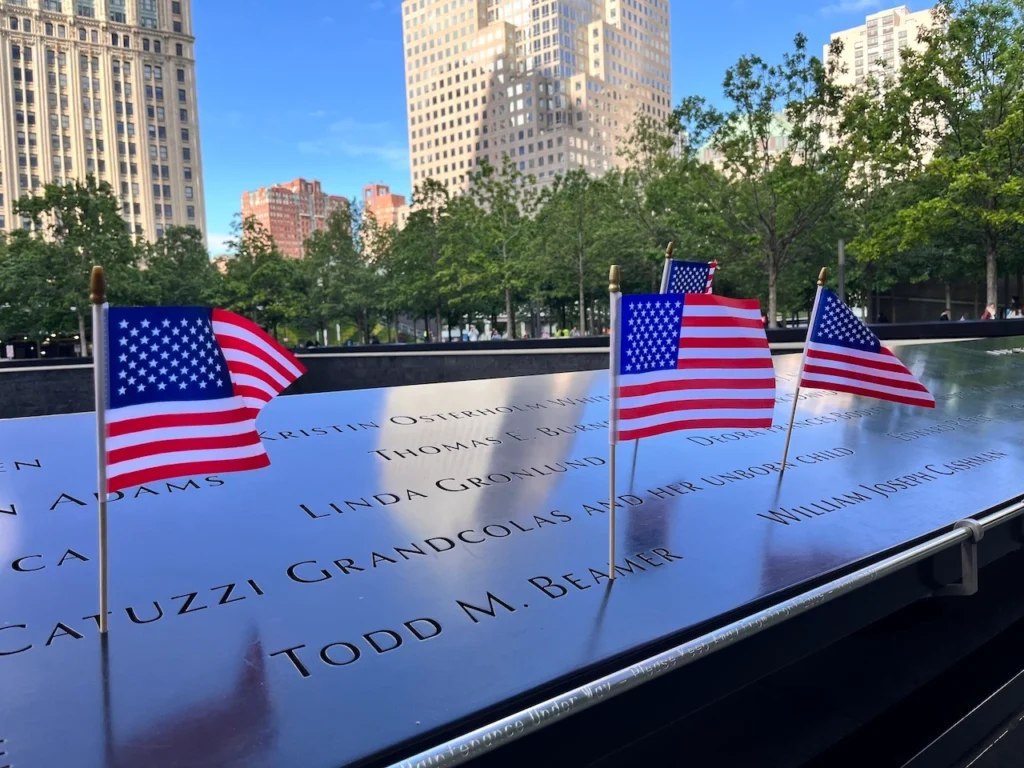
The memorial and museum at Ground Zero is a must-visit when you’re in New York, but it can be a little confusing for first-timers to understand. You see, the National September 11 Memorial and Museum in New York City is two related but separate experiences — the memorial, which is at street level, and the museum, which is actually located underneath the memorial plaza.
The memorial, which opened in 2011, is free to visit, but going with an expert guide who has a personal connection to 9/11, like myself, will enhance your understanding of that tragic day and the rebuilding and renewal of lower Manhattan.
The museum, which opened in 2014 and has an admission fee, showcases thousands of artifacts, photographs, videos, oral histories, artwork, and more to help tell the many stories of 9/11. You can explore the museum on your own, with the help of an optional audio guide, or with a live tour guide.
As a naturally curious person and professional tour guide in New York City, I enjoy opportunities to take off my lanyard and instead be a guest on someone else’s tour. Great tours and experiences expand my knowledge and inspire me to become a better storyteller. I’ve visited the 9/11 Museum several times (I’m a member, in fact), but recently for the first time, I took a tour led by one of the museum’s expert guides.
Here are some highlights from my experience to help you in case you decide to book our VIP All Access Tour at Ground Zero.
The tour experience
After I cleared security inside the ground-level museum pavilion, I hopped on the escalator and descended into the museum proper. I checked in at the tour desk, located just to the left of the escalator, and picked up headphones so I could hear the tour guide’s commentary without other museum guests being disturbed.
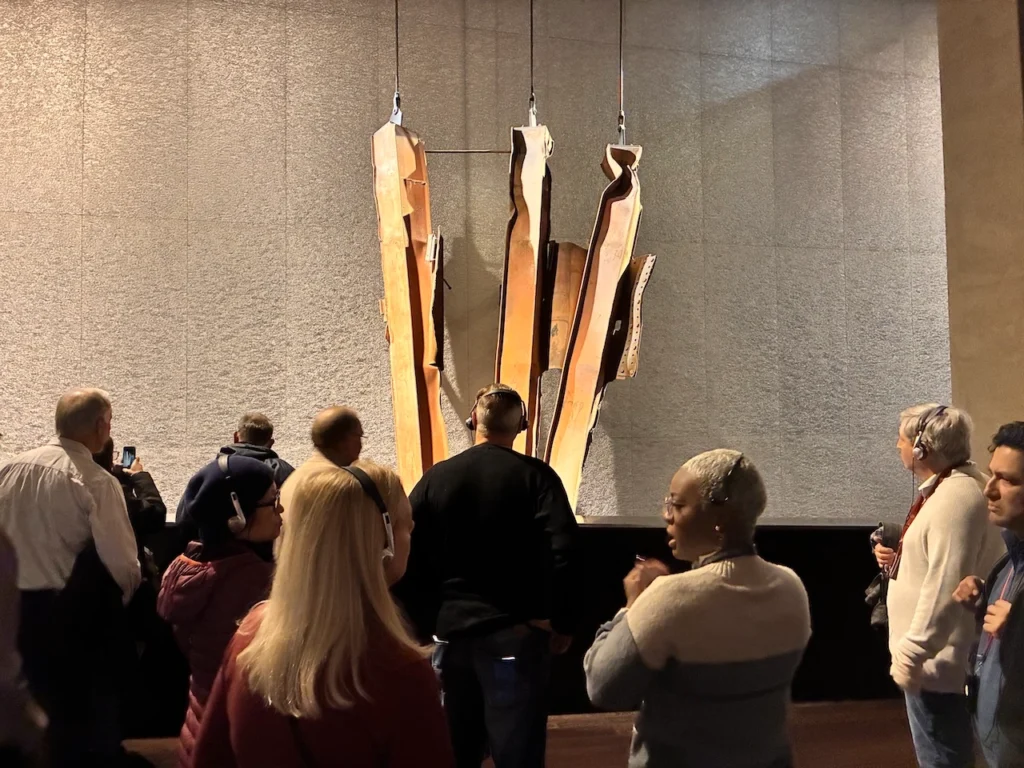
Then I and other tour guests met the guide, Nicole Richardson, the museum’s director of interpretive programs.
She explained the mission of the museum: to honor the victims of the terrorist attacks on September 11, 2001, and February 26, 1993 (when a bomb-filled van detonated in an underground parking garage), and to educate visitors so that the stories live on.
She also gave a short overview of what happened on September 11, 2001: Terrorists from the militant group al Qaeda hijacked four jetliners and crashed them into the twin towers, the Pentagon, and a field in Pennsylvania. In less than 2 hours, nearly 3,000 people died.
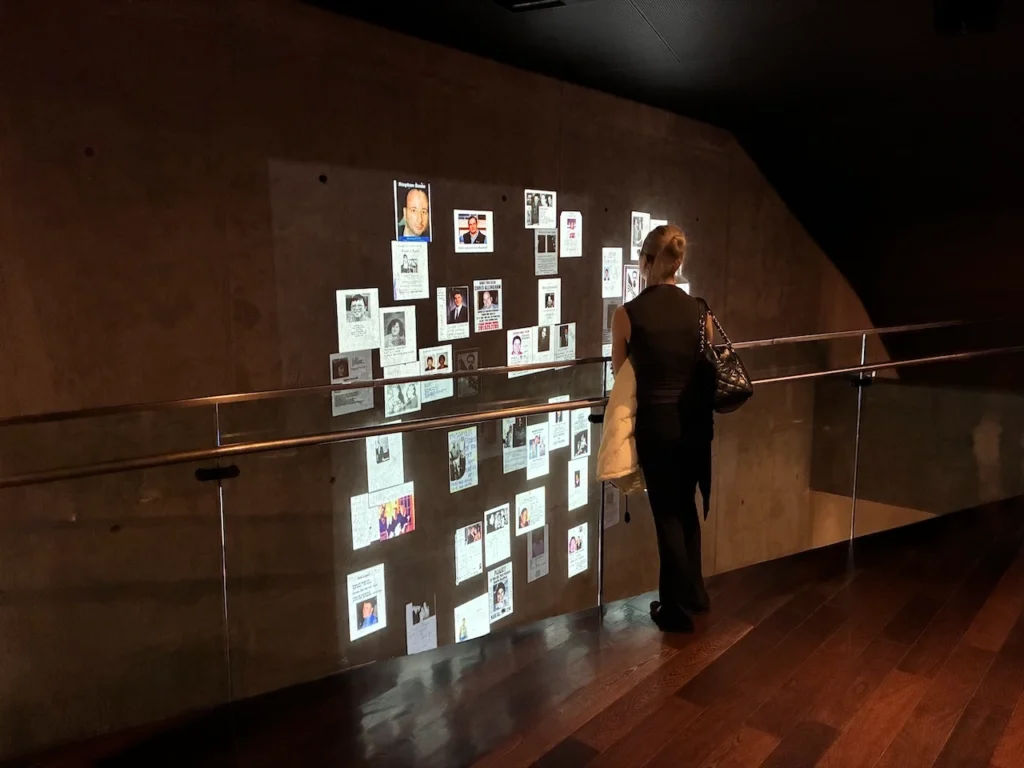
After this introduction, Robinson brought us through a hallway to listen to a soundscape of recordings of people from around the world recounting what they remembered about 9/11. Robinson said these oral histories illustrate the global nature of the tragedy — millions of people around the world watched the attacks and aftermath unfold.
After the soundscape, we descended further into the museum along a gently sloping ramp, passing several images and other exhibits.
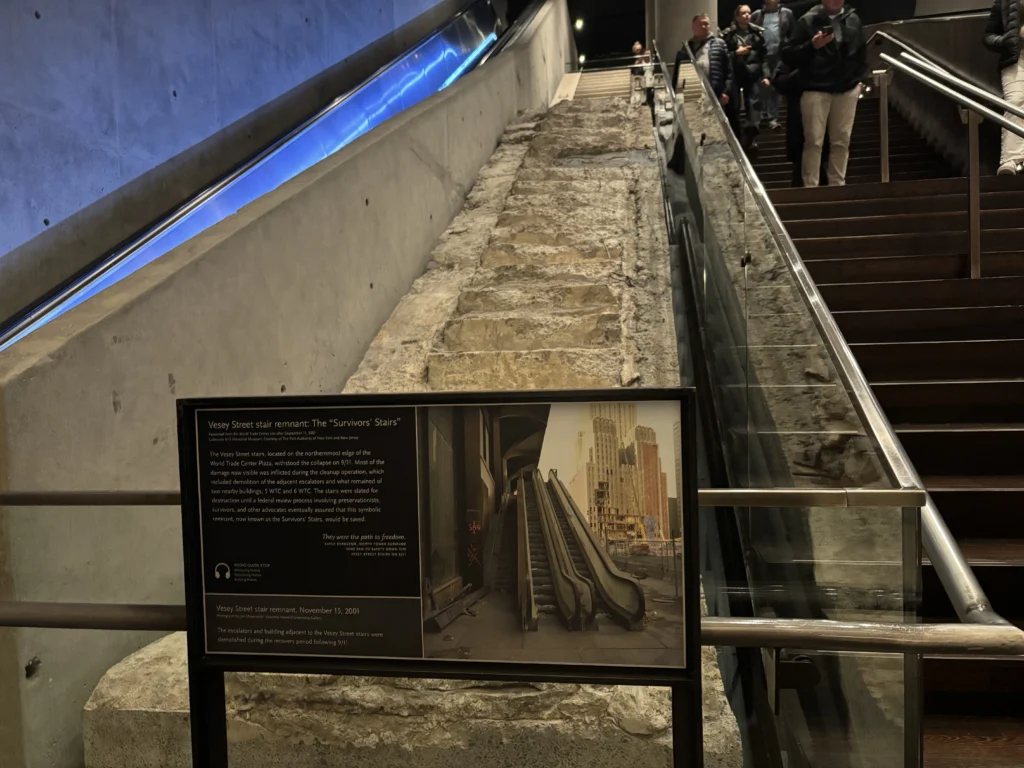
The final descent was via an escalator alongside an installation of the so-called Survivor Stairs — a concrete staircase (salvaged from the wreckage of the World Trade Center) that was the escape route of hundreds of people fleeing the burning site on 9/11.
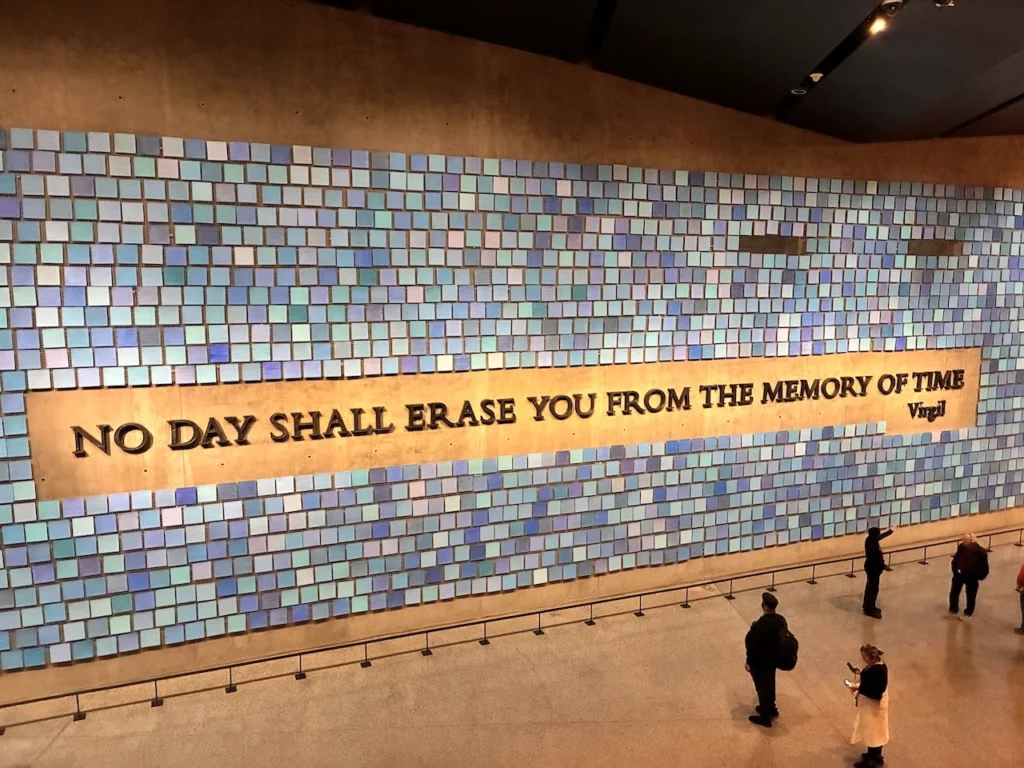
We had arrived at Memorial Hall, which Robinson explained was 70 feet below street level, near bedrock. Here we viewed an extraordinary installation of two works of art.
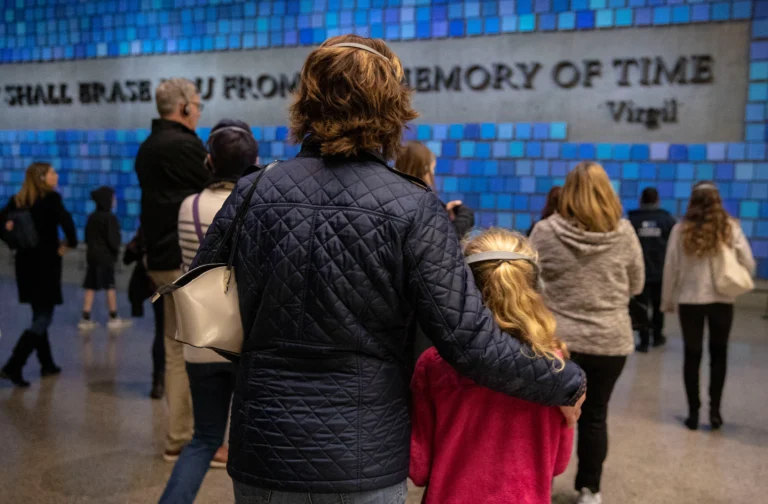
First, 2,983 watercolor squares mounted on the massive wall — each a different shade of blue and each representing every victim of the 1993 and 2001 attacks. This work, by artist Spencer Finch, is titled “Trying to Remember the Color of the Sky on That September Morning.”
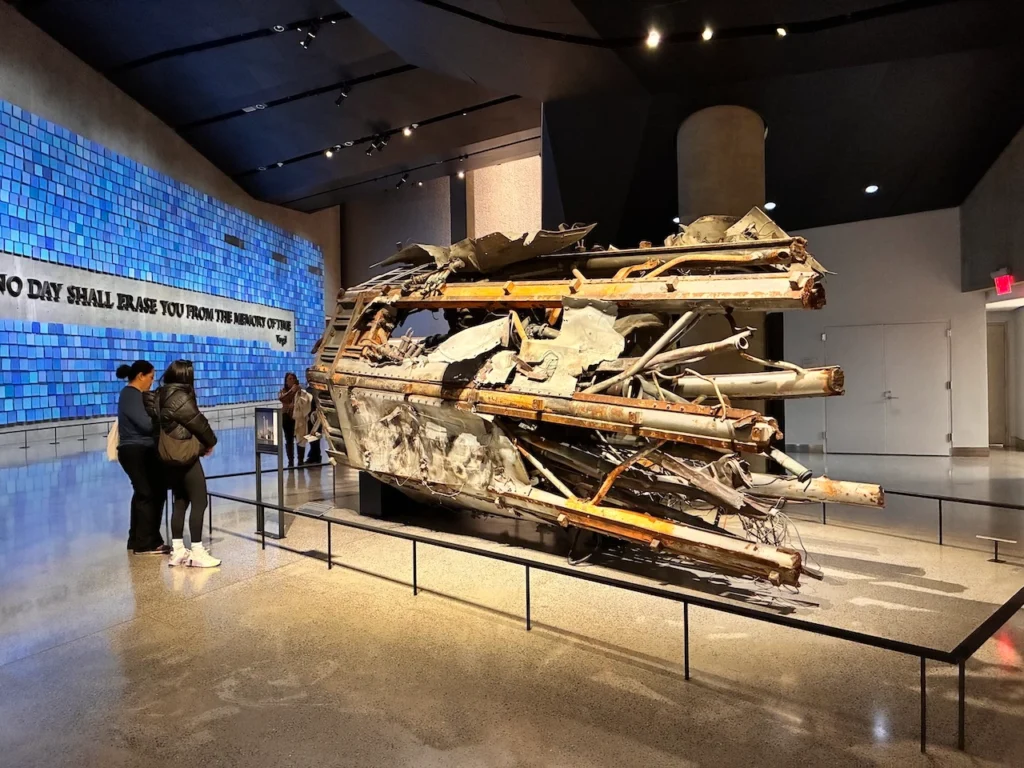
It surrounds a piece by artist Tom Joyce, who fashioned the quotation “No Day Shall Erase You From the Memory of Time” from reclaimed World Trade Center steel. The words come from “The Aeneid” by the Roman poet Virgil.
I spent a few minutes marveling at the emotional heft of such a simple combination and had to actually catch up to the group, which had moved on to another part of the museum.
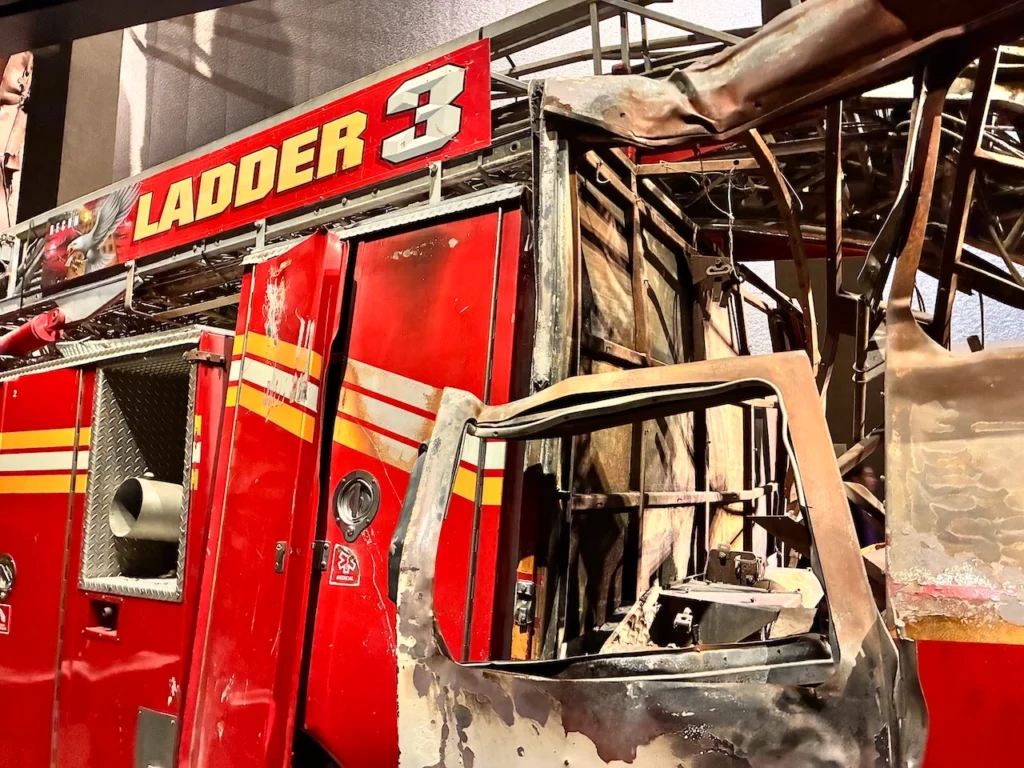
I examined several exhibits showcasing artifacts such as a piece of the broadcast antenna that sat atop the north tower and a severely damaged fire truck from Ladder Co. 3. While showing us these exhibits, Robinson added context and color to enhance our understanding of what we saw. She also recounted stories of tragedy as well as survival, such as how window washer Jan Demczur helped get himself and five others out of a stalled elevator on the 50th floor of the north tower thanks in part to his squeegee blade and handle.
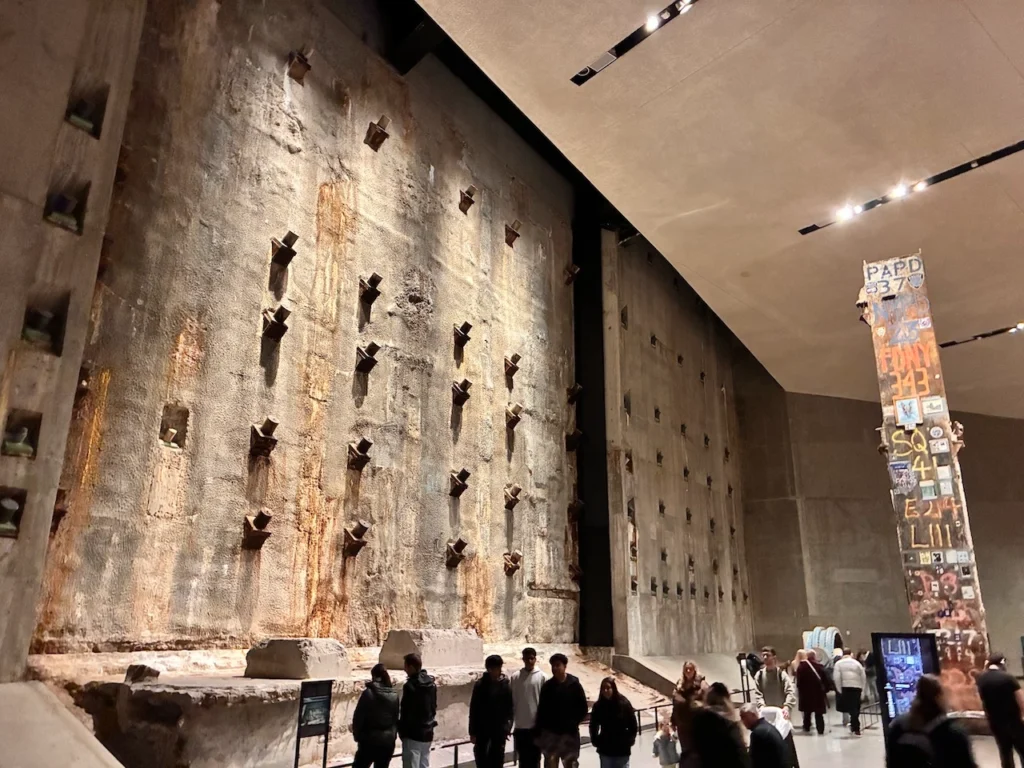
The tour ended in what is called Foundation Hall, which features several more exhibits and artifacts, including the so-called Last Column — a piece of steel that recovery workers removed from Ground Zero in a ceremony in May 2002, marking the end of the recovery stage.
One side of Foundation Hall is actually the exposed slurry wall, which was built in the 1960s to hold back the waters of the Hudson River while workers dug down to bedrock and then constructed the foundation of the twin towers.
Robinson said every tour guide conducts the tour a little differently, recounting different narratives and emphasizing different exhibits. But their North Star remains fulfilling the museum’s mission and by offering visitors a helping hand.
“Many people who come here are reliving their own memories of 9/11 for the first time and may not know what to expect so we carefully guide people through this massive space, through a very difficult story, and share stories of hope, resilience, and remembrance,” Robinson told me. “We hope that when you leave here, you will have learned something about yourself and something about how we relate to others in the world — because 9/11 was a global event.”
After the tour
Tour guides encourage visitors to explore the museum more on their own after the tour ends, which I did.
The historical exhibition’s collection of artifacts, photos, testimonies, and audio and video recordings chronicle 9/11, the events leading up to that day, and what came after. (A warning though: This exhibit is an unvarnished recounting of the tragedy and isn’t recommended for young children.)
A must-see exhibit is “Faces of Ground Zero” by photographer Joe McNally, who captured images of the people who came to Ground Zero to help the rescue and recovery efforts. The installation showcases 18 large portraits from his full collection.
Another powerful exhibit is “Drawing Meaning: Trauma and Children’s Art After 9/11,” which showcases art created by children in the wake of the attacks.
As the museum website explains it, “They expressed the fear, sadness, and anxiety that so many adults experienced after 9/11. But their pieces also show the hope and inspiration that they took from witnessing acts of charity and generosity in the aftermath.”
Your visit to the 9/11 Museum
Whichever way you choose to experience the 9/11 Memorial and Museum, you’ll likely take so much away from your visit and learn new things about that dark day and beyond, which I did. You’ll carry that knowledge and those emotions with you long after you leave.
And, hopefully, share them, too.
Feature photo credit: Jin S. Lee